This list of the common American and European paper sizes includes the ISO standards, which are used globally. All dimensions are specified in inches, millimeters as well as PostScript points (1/72 inch, always rounded off). The overview covers:
- ISO page sizes – The ISO A series is the most frequently used page measurement standard. It includes the DIN A4 format. The ISO B sizes are used for poster printing while ISO C is meant for envelopes. The SRA standard defines press sheet sizes and is used in the printing industry.
- American paper size dimensions – such as ‘Letter’, ‘Legal’ and the ANSI series.
- English sheet sizes – with a focus on formats for writing paper and book printing.
- Newspaper sizes
ISO A paper sizes
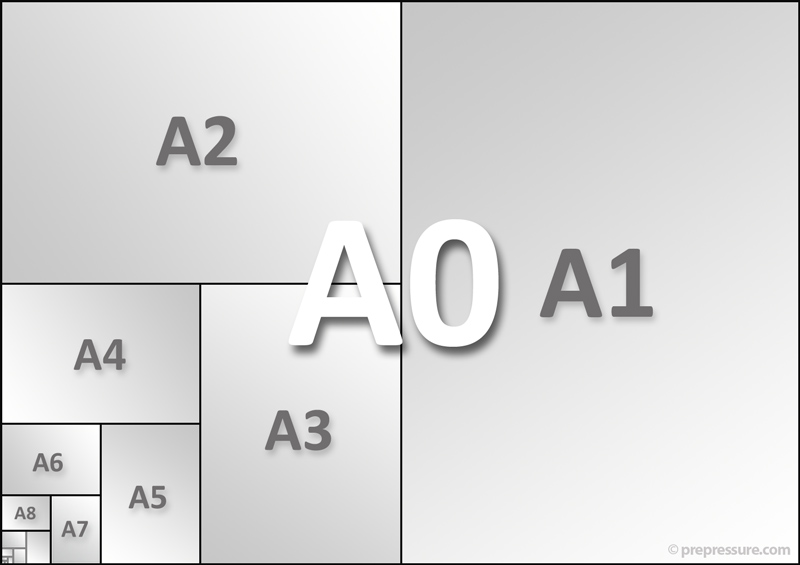
The A-series consists of a logical set of paper sizes that are defined by the ISO 216 standard. The largest size (A0) measures one square meter. The height/width ratio remains constant (1:1.41) for all sizes. This means you get the A1 size by folding an A0 paper in two along its shortest side. Then fold the A1 size in two to get an A2 size paper, and so on… A-sizes are used to define the finished paper size in commercial printing: A4 is for office documents, A5 is for notepads and A6 is for postcards.
|
Millimeters
|
Inches
|
Points
|
||||
|
Width
|
Height
|
Width
|
Height
|
Width
|
Height
|
|
| A0 |
841
|
1189
|
33.11
|
46.81
|
2384
|
3370
|
| A1 |
594
|
841
|
23.39
|
33.11
|
1684
|
2384
|
| A2 |
420
|
594
|
16.54
|
23.39
|
1190
|
1684
|
| A3 |
297
|
420
|
11.69
|
16.54
|
842
|
1190
|
| A4 |
210
|
297
|
8.27
|
11.69
|
595
|
842
|
| A5 |
148
|
210
|
5.83
|
8.27
|
420
|
595
|
| A6 |
105
|
148
|
4.13
|
5.83
|
298
|
420
|
| A7 |
74
|
105
|
2.91
|
4.13
|
210
|
298
|
| A8 |
52
|
74
|
2.05
|
2.91
|
148
|
210
|
This drawing illustrates the principle behind the ISO A series:
ISO B paper sizes
The same logic from the A-sizes also applies for the B-series, except here the starting point was the dimension of one of the sides, which starts at 1 meter. B-sizes are often used for posters.
|
Millimeters
|
Inches
|
Points
|
||||
|
Width
|
Height
|
Width
|
Height
|
Width
|
Height
|
|
| B0 |
1000
|
1414
|
39.37
|
55.67
|
2835
|
4008
|
| B1 |
707
|
1000
|
27.83
|
39.37
|
2004
|
2835 |
| B2 |
500
|
707
|
19.69 |
27.83
|
1417
|
2004
|
| B3 |
353
|
500
|
13.90
|
19.69
|
1001
|
1417
|
| B4 |
250
|
353
|
9.84
|
13.90
|
709
|
1001
|
| B5 |
176
|
250
|
6.93
|
9.84
|
499
|
709
|
| B6 |
125
|
176
|
4.92
|
6.93
|
354
|
499
|
| B7 |
88
|
125
|
3.46
|
4.92
|
249
|
354
|
| B8 |
62
|
88
|
2.44
|
3.46
|
176
|
249
|
| B9 |
44
|
62
|
1.73
|
2.44
|
125
|
176
|
| B10 |
31
|
44
|
1.22
|
1.73
|
88
|
125
|
ISO C paper sizes
C-sizes are used for envelopes to match the A-series paper. I have omitted unrealistic sizes like C0 (imagine an envelope measuring 917 by 1297 millimeters).
|
Millimeters
|
Inches
|
Points
|
||||
|
Width
|
Height
|
Width
|
Height
|
Width
|
Height
|
|
| C2 |
648
|
458
|
25.51
|
18.03
|
1837
|
578
|
| C3 |
458
|
324
|
18.03
|
12.76
|
578
|
919
|
| C4 |
324
|
229
|
12.76
|
9.02
|
919
|
649
|
| C5 |
229
|
162
|
9.02
|
6.38
|
649
|
459
|
| C6 |
162
|
114
|
6.38
|
4.49
|
459
|
323
|

ISO D paper sizes
I have no idea what D-sizes are used for but the standard is there so it should be mentioned.
|
Millimeters
|
Inches
|
Points
|
||||
|
Width
|
Height
|
Width
|
Height
|
Width
|
Height
|
|
| D0 |
1090
|
771
|
42.91
|
30.35
|
3090
|
2186
|
ISO RA & SRA paper sizes
These oversized papersizes are used by printers. The dimensions in millimetres are rounded to the nearest value.
|
Millimeters
|
Inches
|
Points
|
||||
|
Width
|
Height
|
Width
|
Height
|
Width
|
Height
|
|
| SRA0 |
1280
|
900
|
50.39
|
35.43
|
3628
|
2551
|
| SRA1 |
900
|
640
|
35.43
|
25.20
|
2551
|
1814
|
| SRA2 |
640
|
450
|
25.20
|
17.72
|
1814
|
1276
|
| SRA3 |
450
|
320
|
17.72
|
12.60
|
1276
|
907
|
| SRA4 |
320
|
225
|
12.60
|
8.86
|
907
|
638
|
| RA0 |
1220
|
860
|
48.03
|
33.86
|
3458
|
2438
|
| RA1 |
860
|
610
|
33.86
|
24.02
|
2438
|
1729
|
| RA2 |
610
|
430
|
24.02
|
16.93
|
1729
|
1219
|
American paper sizes
The US and Canada do not use the international standards but instead rely on the paper sizes below. The ANSI standard was added in 1995 to create a set of sizes that are based on shared dimensions. It lacks however the consistent aspect ratio of the ISO A-series.
|
Millimeters
|
Inches
|
Points
|
||||
|
Width
|
Height
|
Width
|
Height
|
Width
|
Height
|
|
| Letter (ANSI A) |
215.9
|
279.4
|
8.5
|
11
|
612
|
792
|
| Legal |
215.9
|
355.6
|
8.5
|
14
|
612
|
1008
|
| Ledger (ANSI B) |
279.4
|
431.8
|
11
|
17
|
792
|
1224
|
| Tabloid (ANSI B) |
431.8
|
279.4
|
17
|
11
|
1224
|
792
|
| Executive |
184.1
|
266.7
|
7.25
|
10.55
|
522
|
756
|
| ANSI C |
559
|
432
|
22
|
17
|
1584
|
1224
|
| ANSI D |
864
|
559
|
34
|
22
|
2448
|
1584
|
| ANSI E |
1118
|
864
|
44
|
34
|
3168
|
2448
|

English paper sizes (writing papers)
The English nowadays use the A-sizes for office and general use. I have no idea whether many of these definitions are still in use today. Imperial and half-imperial still seem to be widely used by artists.
|
Millimeters
|
Inches
|
Points
|
||||
|
Width
|
Height
|
Width
|
Height
|
Width
|
Height
|
|
| Foolscap |
336
|
419
|
13.25
|
16.5
|
954
|
1188
|
| Small Post |
368
|
469
|
14.5
|
18.5
|
1044
|
1332
|
| Sheet and 1/3 cap |
336
|
588
|
13.25
|
22
|
954
|
1584
|
| Sheet and 1/2 cap |
336
|
628
|
13.25
|
24.75
|
954
|
1782
|
| Demy |
394
|
507
|
15.5
|
20
|
1116
|
1440
|
| Large Post |
419
|
533
|
16.5
|
21
|
1188
|
1512
|
| Small medium |
444
|
558
|
17.5
|
22
|
1260
|
1584
|
| Medium |
457
|
584
|
18
|
23
|
1296
|
1656
|
| Small Royal |
482
|
609
|
19
|
24
|
1368
|
1728
|
| Royal |
507
|
634
|
20
|
25
|
1440
|
1800
|
| Imperial |
559
|
761
|
22
|
30
|
1584
|
2160
|
UK metric book printing sizes
For books A-sizes often aren’t used because A4 is too large and A5 too small. Metric Royal Octavo and Metric Crown Quarto are 2 frequently used sizes that are more comfortable to hold and read.
|
Millimeters
|
Inches
|
Points
|
||||
|
Width
|
Height
|
Width
|
Height
|
Width
|
Height
|
|
| Metric Crown Quarto |
189
|
246
|
7 7/16
|
9 11/16
|
536
|
697
|
| Metric Crown Octavo |
123
|
186
|
4 13/16
|
7 5/16
|
349
|
527
|
| Metric Large Crown Quarto |
201
|
258
|
7 7/8
|
10 3/16
|
570
|
731
|
| Metric Large Crown Octavo |
129
|
198
|
5 1/16
|
7 13/16
|
366
|
561
|
| Metric Demy Quarto |
219
|
276
|
8 5/8
|
10 7/8
|
621
|
782
|
| Metric Demy Octavo |
138
|
216
|
5 7/16
|
8 1/2
|
391
|
612
|
| Metric Royal Quarto |
237
|
312
|
9 5/16
|
12 1/4
|
672
|
884
|
| Metric Royal Octavo |
129
|
198
|
5 1/16
|
7 13/16
|
366
|
561
|

Newspaper sizes
The dimensions of newspaper pages are not that strictly defined, so the average or most frequently used size is mentioned.
|
Millimeters
|
Inches
|
Points
|
||||
|
Width
|
Height
|
Width
|
Height
|
Width
|
Height
|
|
| Berliner or Midi |
± 315
|
± 470
|
± 12.4
|
± 18.5
|
± 893
|
± 1332
|
| Broadsheet |
± 597
|
± 749
|
± 23.5
|
± 29.5
|
± 1692
|
± 2124
|
| Compact or Tabloid |
± 280
|
± 430
|
± 11
|
± 16.9
|
± 792
|
± 1217
|
| Rhenish |
± 355
|
± 520
|
± 13.97 | ± 20.47 |
± 1006
|
± 1474
|
Other sources of information
There are a number of other web sites that list paper sizes and their use. Check them out if you need a second opinion 🙂
I feel like a dolt. But I love discovering conversations about small things that I may have taken for granted, never before aware of the depth and complexity, and history(!) they involve. I have note pads in many sizes and now I’ll go through them and measure them to see if I can assign them proper names. They are not all from the USA. I have some European and Asian (India and Japan). It’s the paper itself that has been my interest. Now my interest has been multiplied. Thank you for the site, and thanks to your many readers for their comments.
Wonderfully nerdy, thank you.
I have printed sheet music from several different American publishers that’s 9″ W x 12″ H. It’s the sort of pieces that an amateur or school concert band would play. I don’t see that size in your list and I wonder if that’s some sort of music industry standard.
I am looking for the equivalent of 8 3/8 in x 10 7/8 in (213 mm x 276mm). What’s the name of the paper with this size?
Here’s some info (for US readers) that might save them some frustration.
Until recently it wasn’t that hard to find 3-hole punched half-letter/statement/note-size paper in both office supply stores and places like Walmart and Target. It was a convenient size – not as bulky as standard letter size paper – but still large enough to hold a reasonable amount of notes. Finally the paper was punched and decent binders were affordable so it was easy to keep the information up-to-date. I’ve used plenty of spiral-bound notebooks of the same size but one of the aggrevations is that you can’t insert pages or move them around. So they get ‘fuzzy’ with all of the tabs on the pages, and/or it starts looking really lame because I’ve ripped out so many pages of outdated information.
There were 6-ring binders with A5 paper but they were part of expensive day planner kits. (There’s also 7-hole punched paper that works with either but it’s hder to find.)
However for some reason a few years ago the half-legal paper started disappearing, then the binders and other things. It’s now gone entirely from Target (at least locally), and I think Walmart has also either fully dropped it or you can only get small packs of ruled paper for $$$. The local Staples still has binders and separators but no paper.
I’ve looked for modest A5 binders, 3- or 6-ring, but they still seem to be focused on fancier day planners than utilitarian notebooks. Note the current half-legal binders at Staples aren’t exactly cheap – they’re around $10 – but that’s a lot less than the 6-ring binders and don’t have unwanted extras like a cloth cover and strap. I just want something where I can keep my paper notes someplace convenient and in something that may not be ideal conditions. Otherwise I would just keep my notes on my ipad.
That said… you can still find half-letter paper on Amazon. Lined or unlined, 3-hole punched or not.
But now the fun bit….
One of the reasons I use a laser printer is that the pages don’t smear when they get wet. They can also print unusual sizes. With my last printer I would routinely print 3×5″ cards, but with my current printer I can’t print below 4×6″ cards.
A lot of my notes fall into a category where I’m essentially filling out a form. It’s a pretty simple process where I can print out some blank forms that I complete by hand as necessary, and then re-print the completed forms for future reference.
Fine… but either my printer or Libre Office (or both) have quietly had an update such that they no longer handle half-letter size. I can still put the paper in the software and/or printer insist on rescaling what’s printed. (I haven’t tried printing to PDF and then printing that – and I’m not even sure that would work.)
Half-letter and A5 paper are almost the same size – they’re close enough that I can put the A5 paper in the half-letter binder. But you have to check this on a case-by-case basis – the paper may brush against the tab you push to ppen the rings, or might extend a little too far to the sides.
Maybe this will all shake out in a few years – we’ll be able to get inexpensive but decent binders etc. for A5 paper, using either 3- or 6-hole punches – but for now it’s something to keep in mind if you want to create notebooks this size.
Why isn’t there a standard book size based on 8.5 x 14, folded to 8.5 x 7 for 4 pages (front and back)? Home printing is crazy difficult because it’s so hard to find quality printer paper sized to fit a home printer and to find printers that will print on standard sizes and even more difficult to find equipment reasonably priced to cut large sheets designed for large market printers down to standard book sizes.
It’s called Legal Size paper (8.5×14). I use it for exactly the same thing. Very useful.
Thank you for this information, I am a paper conservator and it is really useful to know sizes and names of paper.
Sam
I am looking for 5 1/2 X 8 1/2 or the equlvalent of and preferably 3 hole punched. Have any idea where I can find that?
The only paper that size with 3 hole punch that I have been able to find is already lined or printed sets, and they cost more than I am willing to pay. I buy a ream of 8.5 x 11 and have it cut in half at the store. They will usually do this for a small fee (like $1). Some stores will punch it as well, but most are not equipped to 3-hole punch paper that size. I usually do it myself. It’s effort, but I get exactly what I want for far less than I would have to pay for almost what I want.
Found on Amazon…both lined and unlined, 3 hole punched. EZPZ
HELP! I need to find a source for a paper tray/organizer (preferably stackable) for A2-sized paper. I have seen these in archives and historical societies where they have trays of maps printed on large sized paper, but I have been unable to find such a product anywhere.
Why humans complicate everything, like if using a different size or thickness of paper will change what is written on it. Funny!
That is an odd point of view because it seems to imply that standardization adds needless complexity. It is actually meant to simplify things and reduce mistakes or misinterpretations.
One standard would be a simplification. All of these different standards complicate things. Having so many different “standards” rather defeats the concept of a standard. What mistake or misinterpretation is avoided by changing the paper size? Are we thinking that the shape or size of the paper is assigned to certain tasks only? Perhaps diplomas on A5 and legal documents on ANSI B? That might make things more efficient for those handling large quantities of paper that have different purposes. But the point that was being made was that the paper size does not alter the meaning of the content. We standardize electronic components and other things. Why not ‘actually’ standardize paper?
Which is the best paper for printing gym exercise posters
That is something that you better discuss with your printer.
this helped a lot ty
Do you have any information on a print size of 11 7/8 by 8 7/8?
where the hell is 20×30 inches?
I did not include any of the older English uncut printing paper sizes in this overview. They indeed include the 20×30 inches Double Crown size.
You mention that you’re not sure what the ISO D sizes are for – they are envelope sizes for the B series, much like C are envelope sizes for A.
hi…
i am using html2pdf to convert html to pdf… actually i have a large size of html container like 12x12in (inches).
and i have used A4 size for the first time then my html content not showing completely till as per the size (12×12 in) then i have look into your site and i found all paper size here.. thanks for that important info…
but now, when i have used A3 size i have found, my all html content inside the pdf file….but there are so much space at the bottom of my contents in pdf…
So i want to know… IS there any way to reduce this space from the pdf or any other way to convert html to pdf with manually defined page height and width…
Thanks in Advance.
Hello…
can i increase height and width of A4 paper size?
Actually i have a div with size of 12×12 inches and i want to create a pdf of it… and i have tried A,B,C and all related paper size. But output is 8.27×11.69 inches… How can i do this.. please help!!!
Thanks in Advance….
You don’t seem to have a problem with a paper size, you struggle with a printer driver or export settings. I can’t help with those.
thank you so much
What is the standard size of books that are published in the rest of the world other than England and the U.S.?
I am writing up a family history that will be printed in Germany and would like to utilize a size that they would be familar with.
They will print any size you want, using a bigger size and cutting it to spec. You should ask about cost per piece.
Don’t forget there is printing on demand, which is s bit more expensive but you do not have to print a big number of books to keep in stock somewhere.
Good post. I be taught something on completely different blogs everyday. It’s going to all the time be stimulating to read content material materials from other writers and comply with just a bit something from their blog.
MY original post on this topic was ‘ Why is it that UK bank statements (and some other official documents), use paper that measures 300mm X 210mm – i.e. just 3mm longer than standard A4? It matters. because it won’t fit in a standard copier feed tray.
… and I thought that size doesn’t matter …
Regarding your observation: American paper sizes lacks the consistent aspect ratio of the ISO A-series.
You are absolutely correct!!!
That is because in the decades prior to Personal Computer, the US Standard “Letter” Sizes were for designed for the draftsman: the kind-a guy sitting at the angled desk with the only electrical device in sight would be the light bulb (he EVEN had to manually sharpen his own pencils).
Size A is 8-1/2″ x 11″ inches (how they determined that I do NOT know).
After that (B,C,D,etc.) sizes either doubled in width and/or height as needed for drafting (the biggest ones were nick-named bed sheets).
At one time I the task of printing out blue prints stored on microfilm embedded in punch cards: I think F is the largest size I remember seeing on a regular basis but I am almost positive that they go larger than that (I mean in the US Standard Letter Sizes).
Most of the blue prints stored on microfilm that I saw were of size D or E.
BTW You can add 2 additional US Commercial Standard Paper Sizes (mostly for historical purposes):
#1 Statement size: 8-1/2 by 5.5 (also known as the half sheet)
As a kid I always thought that the half-sheet was just a letter size sheet of paper physically torn in half.
I recently cleaned out an office that had numerous forms printed in the 1970’s.
The forms that were not letter size were statement size (exactly half the size of the Letter-Size sheet of paper 🙂
#2 US Standard Fan-Fold (aka green bar): 14-7/8″ by 11″ – These are/were for the wide pin-feed (teletype / industrial / factory) printers.
Just FYI, Tracey
The different sizes for drafting documents in the United States. The ANSI A through E are for engineering drawings. There are a few additional sizes recognized for engineering drawings. ANSI F, which was 28×40 and mainly used for Naval designs, and G (11×22.5 to 11×90), H (28×44 to 28×143), J (34×55 to 34×176), and K (40×55 to 40×143) which are roll length drawings. Architectural drawings are another set of sizes altogether.
I wanted to change Letter to A4, but then I had to choose from a new dropdown: A4 1/4, A4 1/3. What is that?
Width should always be before height. The end.
If you are referring to my post width is before height.
Actually, width should NOT ALWAYS be before height. The grain direction for the leaf (i.e., sheet of paper) is indicated by the first dimension that is stated. Grain direction is important when printing because having the grain direction running parallel to the direction of the spine or spine fold of the content being printed is the desirable condition. This reality of paper grain direction is one of the fundamental, basic essentials in publishing and printing.
I am going to be getting a book printed do you have any suggestions on what size I should set it up for. Will be a small book currently is 91 pages 8.5 x 11(Letter)
We have music printed on 14″ x 10″ paper and then folded. Can anyone tell me what paper size this is and where it can be bought
Why do UK banks and some other ‘official’ bodies print statements on paper that is about 2mm longer than the standard A4? i.e. 210mm X 299mm
What is the percentage increase from A5 to B5 paper size.
Hopefully someone can help?
I have a question… what would be the actual size of an oversize ANSI E?
Thanks!
Found this if it helps anyone
http://www.scrivs.co.uk/1/a1-paper-size.html
Do u have any information on how to fold E-size paper to fit in 11X17 binders? Would appreciate it greatly.
T. Ward
the information on this site is quite helpful. I can now comfortly choose a size that is close to what I have in mind.
To me, ISO paper sizes remained the standard measuerements.
Thanks.
Hey I’ve been told by my boss to print a document in 7.25 x 9.5 inch size.
Does this dimension have a name? Is it a ‘popular’ size?
This is most likely way too late. No it’s not a common one. The paper is the Executive, Monarch
Data is clear and i got a timely help
hi,this site is very useful 4 me.if i get any problem,sorted out by u.thx a lot.
Thanks to your website, we discovered a book we had was size A6. We needed that size to correctly scan the document quickly, without cropping. Adobe Acrobat rotated the pages correctly.
Thanks for your help!
In the UK I use A4 for document originals and print A5 for their booklet equivalent.
What size of .pdf document will allow the US to print a Letter sized original but still print a 1/2 sized booklet.
Any advice would help
Thanks
Christopher,
If you have not found your answer regarding, “elephant”, I will try to give you one. Elephant is an traditional English Paper & Book size of paper. The basic size is 23″ x 28″ or 584mm x 711cm.
Frank
Hi,
i am an IT admin/supervisor from middleast
it helped me for my thirdparty erp’s
Thanks for Ur Effort
Ur Effort Appreciated
sd/mir shaukat ali
(indian)
Hi T. Ward,
What is the standard printing size for documents in India? A4, letter, other?
Thanks!
As far as I know it is A4 – which was adopted as the national standard in 1957.
dear sir
i am starting a new printing press so i need information reguarding printing pls help me
Sir,
It is not wise to enter in any business which is unfamiliar.
will you please tell me which type of paper use in laundry dry clinning bill book. what is a quality of paper which goes with keep with cloath as tag to identify customer cloths
Hi
I am greatfull to you all, since i m working as a print production supervisor.This chart is very much helpfull to me, Thanks to people on NemLaxmi Pvt. Ltd
Thanks for telling me this we where talking about why the bigger the number the smaller the page size so thanks!
Is it possible to have it sent to my email box
Great job.Very useful and helpful for printers
Chris PrintEdge Ltd, Nigeria
Thanks for informations
Neat … love the comments too … have a look-see at – http://en.wikipedia.org/wiki/Paper_size – mentions ‘elephant’ size there.
It is funny for me to read all this comments and questions about paper sizes.
For me as German the sizes are crystal clear with our DIN A (Deutsche Industrie Norm) now named ISO for international understanding. I fully agree with Alistair about the ignorance of America in that matter.
Sunny regards from Athens, Greece
Juliane
Thanks
Your website is really helpful for the architectural students like me.
Thanks once again
Your listings are very helpful as a Brit, expatriated to USA now back in UK again.
I am looking for a UK source for Legal & Letter size hanging files for my US office furniture I brought back. Any ideas?
Thanks, Feebs
What a mine of useful information!
Thank you for taking the time to let me have this valuable info. My query was regarding SRA3 which I have had answered admirably, thanks.
It is true then, size is everything, certainly when it relates to paper!
Have a great day!
Tony
Excellent! Informative and helpful article. Thanks for the useful, well presented and consise info.
Anyone who’s ungratefully pedantic enough to be upset or offended by it, please supply dimensions of the cavity you’d like me to insert the paper into and I’ll duly oblige. American, ISO or English measurements accepted! For some on here, I’ll prepare the A0 heavyweight stock.
Have a nice day!
i actually wanted to know the names of the various types papers used in printing industry. it seems u dont have the info.
I have a ledger I purchased in Oxford in 1969 the size of which was described as “elephant folio”.
Does this size still pertain?
Thank you.
Do you have a pdf version of this info..
Any paper with size 6.5in x 9 in.?
thanks so much
The “D0” is an exact match to the HP plotter that I use.
Can anyone help with , L & L2 ? Thanks
This is most likely very too late for you. However, I’m trying to learn the difference between Hagaki, Wallet, Passport, l, & 2L for a personal photo collage project I’m working on. The L is 3 1/2 x 5 The 2L is 5×7.01 like a post card w/ a borderless photo.
Duncan, this is most likely way too late for your answer. I’m working on a kind of a collage photo like project. I’m throwing together a bunch of different pics together on an 8.5×11 photo paper (A Letter). During tips of how to put multi pics on 8.5×11 , it gave a break down of how many different size pics can fit on this size. I ran into the Passport, Wallet, Hagaki, L, & 2L. I’ve been googling the difference between all these sorts of papers. The 2L (or 5R) is 5×7.01 like a post card borderless photo. The L (3R) is 3.5×5 of Photographic Paper.
Thanks a lot. I found it very useful .Anytime i need help of papersize I refer it.
Prashant
Hi, I am trying to find out what paper size for a publication that folds over and is (when folded) letter size or 8.5×11? Do you know what software and printers to use for this size paper?
If you want to simply fold a page along the shortest side to end up with a letter size document, you need to use a tabloid size page (11×17″). If it is a more complex folding scheme you are after, such as a gatefold or one or two folding panels, then each panel needs to be smaller to compensate for inaccuracies in folding and cutting. If this isn’t done the edge of the paper will crease when the piece is folded. I think panels that are 1/16″ of an inch less wide is the general recommendation but it is better to consult with your printer.
The regular layout applications like Adobe InDesign, QuarkXpress,… are used for designing folded documents. Typically thin lines in the bleed area indicate where the document should be folded.
Hi
Great list thanks.
Can you help with paper sizes for music. I believe they are quite different.
Sorry, I have no experience with paper sizes for music.
Is there a name or number for 6″ x 3.75″ paper, which is a personal check size? I’d like to think my computer/printer has been programmed with that size but I’m not sure what to ask for.
hi,
I Work as Programmer in Paper Industry In India at
NemLaxmi Pvt. Ltd. This article proves to be helpful to me while studing different paper sizes while preparing coding of finished product for making every product unique.
Thanks.
WHat is a livre demi-poche? And what size is it?
Thanks
I cannot find a definition for it either. A ‘livre de poche’ is a pocketbook, typically 130×190 mm. ‘Demi-poche’ could be a half-size version but I cannot find any dimensions for it. I’ll ask one of my French colleagues, maybe they know.
It has taken me 70 years to get curious enough about sizes of paper and envelopes and paper. Your site has fulfilled that curiosity most admirably! Thank you.
Your information is ok. but can get a bit more stuff cause i still did not find wat i was looking for. I was looking for popular paper sizes but didnt get it.
I think it is difficult to list how popular certain paper sizes are. Obviously this depends on the intended usage but there are also big regional differences. Most of Europe sticks to ‘A4’ for letters and general office printing but you won’t find this size much in the US. If anyone has a list, please post a link!
Thank you for the information found on this site. It has been a big help – I have printed it out and put it next to our copier for the staff to see. Knowing the exact sizes of the various papers is a great help.
Whar are the avery size Crds Ib Greeting cards
I do not mind the size issue US and others. To each there own place and size. But I do mind not have copiers with preprogramed enlarge and reduction setting for standards. The common US are list or the common ISO are listed but why not have ISO to US and US to ISO the V and H ratios could be preset and ready for use.
While I agree there really is some logic behind the US paper sizes I suggest the gentleman taking umbrage be a little more sensitive to the US approach to ignoring international standards in this and many related areas.
The US continues to use measurement basis that the rest of the world largely abandoned (except for specific special cases) a while ago. Such changes are obviously not trivial for a population to embrace…but people do quickly adapt. His example of foolscap is a case in point, it is an archaic size and very difficult to find in the UK…the ISO A sizes having been adopted years ago.
It is public record that the US was the last major player to accept SI as legal remarkably recently, and remains the last to not require it on packaging and the like.
The US even insists on a different system of maritime navigation marks whilst everyone else not dominated by big brother uses a different internationally agreed approach.
It should therefore be no surprise if the raison d’etre behind the US approach is less than widely understood outside the US.
I am from the UK but have lived and worked in the US for over decade now. I know from personal experience how unnecessary these differences really are…and a little bit of flippancy in the face of such national arrogance seems totally appropriate to me…even if it was unintentional in this case.
Whoa… tell me about it! Sounds like a genuine paper expert there. Very helpful none the less. Thanks!!
Ouch, I never realized people could be this sensitive about paper sizes. Thanks for the explanation though, which is very informative! I have changed that line of text on the page.
As for this site being a professional site: it isn’t. I see it as my web-enabled notebook. I can only guarantee that visitors get more than what they paid for 🙂 … but I acknowledge that this is no excuse for making mistakes.
Again: thanks for the feedback!
I take issue with your flip comment that there is no apparent logic behind US paper sizes. The American Society for Testing and Materials sets these sizes and they are very logical and easy to remember without resorting to references (see below). Some of these sizes have also picked up synonyms such as “letter” which, I would argue, are no more illogical than British terms such as “foolscap”.
A size is the functional equivalent to UK A4 and is 8.5in by 11 inches. As the letters increase the short dimension is doubled. E.g: B size is 17×11 inches (roughly A3 – also called ledger), C size is 17×22 inches, D size is 34×22, and E size (typically a ‘full-size” engineering drawing) is 34×44.
Special paper sizes such as executive, legal, etc. are marketing names developed by stationary companies and immortalized by the print drivers installed on your computer.
I would have expected more research from a professional printing site.
Wow, what a prick! How’s that for a flip comment?
Good response spoiled by bad spelling : STATIONERY is the word !!
Great summary for the “non-initiated” – thanks!