These pages provide an overview of the evolution of the PostScript page description language. PostScript is now on the market for more than 25 years. It has had a profound impact on the publishing industry and even today remains an important industry standard.
For more information on the history of prepress in general, please jump to this page. Part of this overview is based on ‘Accidental empires’, the book written by Robert Cringely on the personal computer revolution.
The dark ages
To appreciate PostScript, you have to know how the market worked before it became available. In the early ’80s, if you needed typesetting equipment, you went to Acme Typesetters, and they would sell you an Acme system with an Acme output device. Then you would follow at least two weeks of training to learn how to use the system. The Acme system would be incompatible with equipment from any other manufacturer. In most cases, it would even be difficult or impossible to exchange data with other systems.
If you owned a personal computer, you could hook it up to a dot-matrix printer that would output low-quality bitmap characters. Graphics could be done but the quality was only acceptable to the nerds that bought computers in those days.
The beginning – Xerox
The history of PostScript starts at Parc, the research institute of Xerox. This is where many of the computer technologies we now take for granted were developed. The laser printer, the graphical user interface, and ethernet are some prime examples.
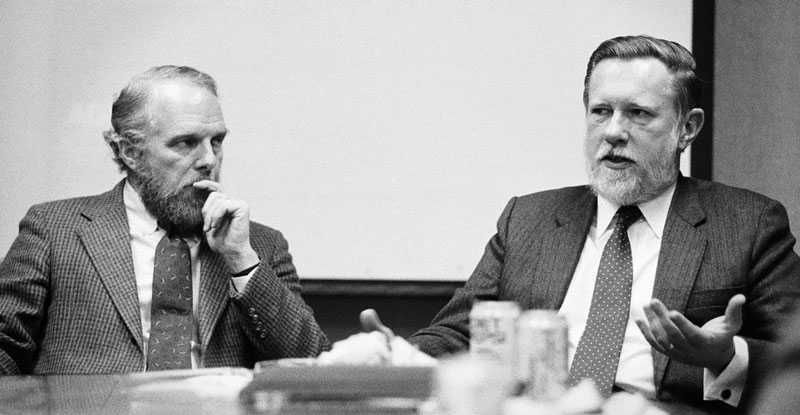
One of the brilliant engineers working at Xerox was John Warnock. He developed a language called ‘Interpress’ that could be used to control Xerox laser printers. He and his boss, Charles M. ‘Chuck’ Geschke, tried for two years to convince Xerox to turn Interpress into a commercial product. When this failed, they decided to leave Xerox and try it on their own. In the picture below Warnock is sitting to the left and Geschke to the right.
Adobe is founded
John Warnock and Chuck Geschke named their company Adobe, after a little creek that ran behind the house of Warnock in Los Altos, California. You sometimes see it mentioned in wine guides on maps of Napa Valley where some of the most famous Californian wines are made.
At first, Warnock and Geschke thought of building a really powerful printer themselves but they soon realized that it would make more sense to develop tools for other manufacturers to control their printers.
It took Adobe 20 man-years to develop PostScript, a language that can be used to control output devices like laser printers.
1984 – PostScript level 1
In 1984 PostScript was released. It was originally just called PostScript. ‘Level 1’ was added later to differentiate it from the more recent Level 2 upgrade.
PostScript is a very powerful language that looks a bit like Forth, another computer language. From the beginning, PostScript needed a pretty powerful system to run on. In fact, during the first years of its existence, PostScript printers had more processing power that the Macintoshes that were connected to them.
PostScript offered some huge advantages that other systems did not offer:
- PostScript is device-independent. This means that a PostScript file can run on any PostScript device. On a laser printer, you get 300 dpi output, while the same file gives you beautiful and crisp 2400 or 2540 dpi output on an imagesetter. For users, this meant that they were no longer tied to one manufacturer and could choose the devices that best fit their purpose.
- Any manufacturer could buy a license for the PostScript interpreter and use it to build an output device.
- The specifications (syntax) of PostScript was freely available so anyone could write software that supported it.
PostScript takes off
PostScript was a pretty big gamble for Adobe and they might have failed to convince the market of its value if it hadn’t been for Steve Jobs from Apple Computer.
In 1985, sales of the Macintosh computer started to fall back and Apple really needed a killer application for its new baby. Steve Jobs liked the technology of Adobe, invested 2.5 million dollars in the company and convinced Warnock to create a PostScript controller for the Apple LaserWriter. This printer was similar to the HP LaserJet but the PostScript controller would allow it to output ‘typesetter quality’ pages. The LaserWriter cost about US$7000. Today this may seem expensive (and it was!) but compare that to the first laser printer from Xerox, which, in 1978, cost US$500,000.
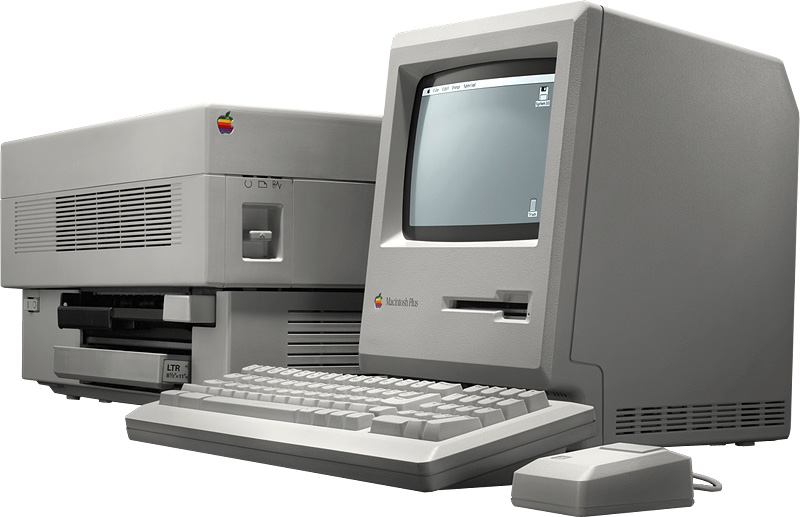
A computer linked to a powerful laser printer would not have made much of an impact but Apple and Adobe were fortunate enough to stumble upon a third partner, a small start-up company that had created an application to utilize the Mac and LaserWriter to their full extent. The company was called Aldus and its software product was called PageMaker.
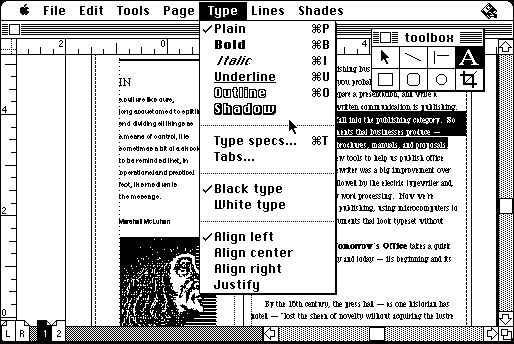
Desktop publishing was born and within a year, the combination of the LaserWriter, PostScript, and PageMaker saved Apple and turned Aldus and Adobe into rich companies. Linotype was the first graphic arts supplier to recognize the value of PostScript and offer an imagesetter with its own PostScript RIP. Other manufacturers soon followed and PostScript quickly became the lingua franca of the prepress world.
1991 – PostScript level 2
Around 1991, Adobe released the next revision of PostScript called level 2. It was a pretty significant upgrade that had been awaited eagerly by the prepress community.
The most important features are:
- Improved speed and reliability: Limitcheck and VMerror PostScript errors got really ugly right before level 2 popped up. Adobe fixed all of this by improving the memory management of its code and by optimizing the code. This also gave us better performance, especially with rotated scans.
- Support for in-rip separation: Level 2 RIPs are capable of receiving a composite PostScript file and performing the color separation themselves. This is not a mandatory feature and there are certainly functional differences between level 2 RIPs from different manufacturers.
- Image decompression on the RIP: Level 2 RIPs can decompress JPEG and CCITT group 4 compressed images.
- Support for composite fonts: This is important for Asian countries that use bigger character sets than we do in Europe. Apple was supposed to support composite fonts through QuickDraw GX. This can nowadays be found in an Apple closet somewhere, next to other breakthroughs like OpenDoc and the Newton.
- Font and pattern caching: With level 2, boring things like font cache deletes disappeared. Pattern caching got picked up years later by some imposition applications like PressWise and Preps.
- Improved drivers: essentially LaserWriter 8 on Macintosh and the Adobe PostScript driver 2.X for Windows 3.1, together with the appropriate PPD-drivers.
- Improved screening algorithms: For a lot of RIP manufacturers, this was old news by the time level 2 arrived. Agfa, for instance, had already been shipping its Balanced Screening technology a year earlier, offering high-quality moiré free screens for offset use. The Adobe version is called Accurate Screening.
The slow adoption of level 2
Adobe made a big mistake by first publishing the level 2 specs and then starting work on the actual implementation. Much to their embarrassment, competitors came up with level 2 emulators faster than Adobe thought possible.
Although PostScript level 2 offered immediate advantages, it took ages before applications actually started using the new functionality. A feature like in-rip separation still wasn’t supported properly by XPress 5, 11 years after the release of level 2.
1998 – PostScript 3
For some obscure reason, Adobe preferred to call the latest update PostScript 3 instead of PostScript level 3. Compared to level 2, PostScript 3 was a fairly minor upgrade. When it was launched a lot of applications were still struggling to support level 2 properly.
 The main advantages of PostScript 3 are:
- Support for more than 256 gray levels per color. Adobe has included 12-bit screening in their PostScript code. This allows for up to 4096 gray levels per color. In the past, the limitation of 256 gray levels was sometimes visible as banding, especially in blends.
- Support for PDF. PostScript 3 RIPs support both PostScript level 2 and PDF-files.
- Improved support for in-rip separation: PostScript level 2 RIPs are already capable of performing a color separation in the RIP itself, but some types of images like duotones or hexachrome images could not be handled in such a workflow. PostScript 3 contains an extra color space called DeviceN. If a non-CMYK color image is encoded in this color space, a PostScript 3 RIP is capable of performing a correct color separation of that image.
- Web-ready printing. In these days of internet hype, Adobe couldn’t stay behind and added some internet functionality to PostScript. Funnily enough, none of Adobe’s OEM-customers seem to have bothered implementing it.
2001 – The great divide
The specifications for PDF 1.4 , released in 2001, for the first time included a couple of functions that had no equivalent in PostScript: transparency and layers.
2006 – The beginning of the end?
In 2006 Adobe announced the Adobe PDF Print Engine (APPE), a complete rewrite of their RIP architecture. Instead of relying on PostScript as its core page description language, APPE uses PDF. Designers can now export PDF files from a layout application such as InDesign. These pages are sent to a printer who uses a PDF-based workflow system to check, trap, and impose those pages. The PDF Print Engine is then used to create plate-ready data. In the entire chain, PostScript is no longer needed.
When asked if Adobe would ever introduce PostScript 4, an update that would include all of the new features made available in PDF, Dov Isaacs from Adobe had the following to say in a thread on the Printplanet forums:
“Absolutely isn’t going to happen. PostScript is a programming language, not really a page description language. By its very nature, it does not provide for really reliable end-to-end workflows since by definition, content can change on the fly. Fun for hackers, disaster for people who need to earn a living.
No, there is not a PostScript Language Level 4 sitting on disk somewhere waiting for marketing to give a signal. Beginning with PDF 1.4, all additions to the Adobe imaging model went into PDF and not PostScript.
To be very clear, Adobe will continue to license PostScript technology through our OEM partners as long as there is a demand for it from their customers. We will also continue support a gateway from PostScript to PDF via our Distiller technology in Acrobat. Adobe will continue to support EPS as a legacy graphics format for import of non-color managed, opaque graphical data into Adobe applications (such as InDesign and Illustrator). Although we certain do not recommend that new graphical content be stored in EPS format (except to satisfy the need to import data into page layout programs that aren’t quite PDF-centric — no need to mention names here!), our user base should feel comfortable that there is no need to worry about a need to convert their very sizable libraries of EPS-based graphic assets.”
Gradual phase-out
The above message already made it clear that Adobe no longer puts any effort into PostScript. In the past decade, the industry has migrated to PDF-based workflows. There are still some isolated cases where PostScript is used, because of the use of outdated software or people unwilling to change their way of working. Since PostScript drivers are increasingly becoming rare, it is only a matter of time before PostScript completely disappears.
The concepts of the PostScript language were seeded in 1976 when John Warnock was working at Evans & Sutherland, a computer graphics company. bye he way this is such a nice blog
I do not agree… PostScript for print industry companies will not disappear until a a replacement that it will do the same an more with more easily. Can someone tell me how we will print in different trays dynamically page by page, based on a condition without PostScript? of course not… and there are more like this that i do not know any other technology that can do it.
The DPart support for production data in PDF 2.0 (including PDF/X-6) as well as support for page level output intents in PDF/X-6 will in fact take care of the issue of multiple page types either pulling different paper types from different trays or even jobs printed with pages printed on multiple printers with varying technologies and substrate types.
Even now, though, various job ticketing schemes can handle some of these issues.
– Dov
Any further updates since in 2012? I’m digging into PDF but would be interested to hear how the older relative is doing.
Very informative and nice. Thanks for writing this up.
yea mitch i missed that face the last time i read this article anyone know why its there?
Very interesting!
I will include in classroom discussion…history of type. Thank you!
Thank you, very helpful! Also, what is with that little smiley face at the bottom of the page?
You must have wasted a lot of time to come up with your posts on this site. Very nice information. Thanks for this. Just added your site to my Google News Reader so i can read more of your posts as soon as they are published.
Very Informative!!!!!!!!!!!!
Thanks!!!!!!!!!!!!
Good research……
This is the most honest and valuable summary about postscript rise and fall.
Well I read this article in 2007 !!
The ISO specs of APPE published in 2012! 4 years after APPE released !
And Just in 2012 Companies starting to implement APPE , while they still use PS 3 as ever in their Rip and DFE.
Still a question ! how long PS 3 will survive as till of today still working good enough.