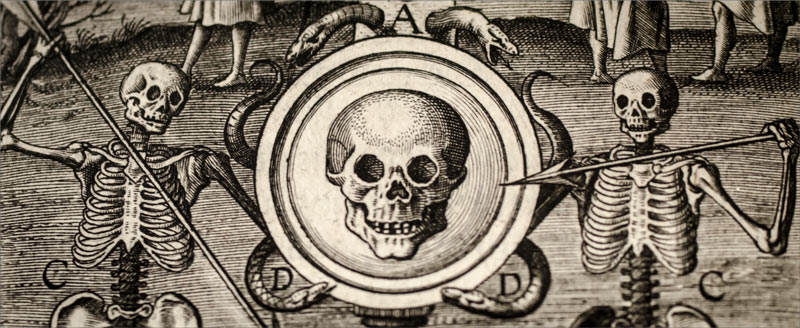
Since the invention of movable type around 1450, a significant part of all printing is of a religious nature. This continues in the 17th century, as illustrated by the closeup below from Duodecim Specula by Joannes David. This book full of moralizing messages was printed by Jan Moretus in Antwerp (1610). New forms of print, such as newspapers and banknotes, do start to appear, however.
The printing press, which had remained largely unchanged since its invention also gets its first recorded improvements. These are made around 1620 by Willem Janszoon Blaeu, a printer in Amsterdam. Blaue is best known as a cartographer, one of the best in an era that is often described as the ‘Golden age of cartography’.
1604 – First English monolingual dictionary
Bilingual dictionaries that translate words from one language (oftentimes Latin) to another have been popular since the invention of movable type. A Table Alphabeticall is the first English monolingual dictionary, created by Robert Cawdrey and intended for ‘the benefit & helpe of ladies, gentlewomen, or any other unskilful persons’. The 120-page book lists 2543 words along with their brief definition. The words are sorted alphabetically, a concept that is so new to many people that the author feels compelled to include a short explanation of how this works.
1605 – First newspaper
Relation aller Fürnemmen und gedenckwürdigen Historien, which is printed from 1605 onwards by Johann Carolus in Strasbourg, is considered the first newspaper. The page shown below is from a 1609 edition. That same year the first German newsletter, the Avisa, is published. Such informational broadsheets were usually called ‘corantos’.

1611 – King James Bible
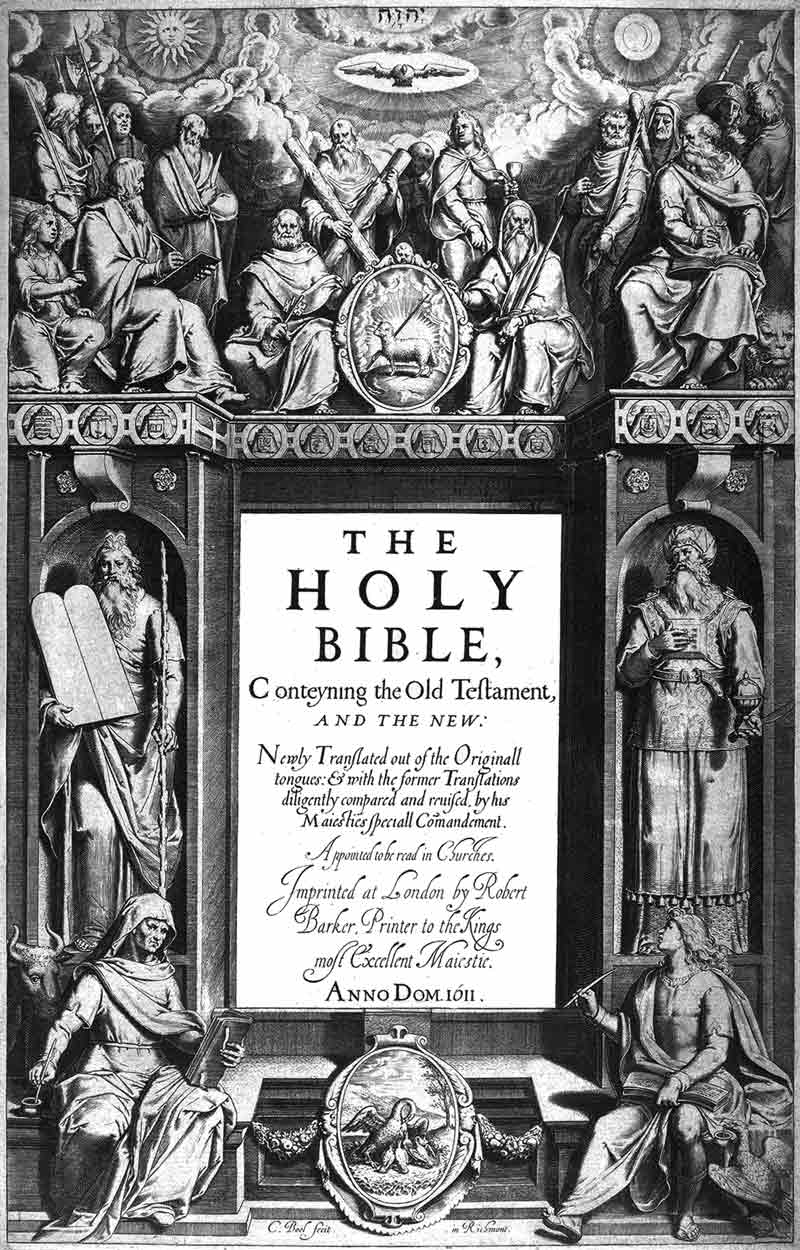
In 1603 an English translation of the Bible is commissioned for use by the Church of England. It is published in 1611 and considered one of the most important books in English culture. The book is sold looseleaf for ten shillings, or bound for twelve.
1620 – Invention of the Dutch press
In Antwerp Abraham Verhoeven publishes the first regularly illustrated newspaper. Nieuwe Tijdinghen (New Tidings but sometimes also called the Antwerp Gazette) is also the first paper to print a headline on the front page. Verhoeven sells his newspaper below production cost and ends up bankrupt. Other printers in the Netherlands also start producing their own newsletters, relying on correspondents from the Dutch East India Company for international news.

Meanwhile in Amsterdam cartographer, publisher and printer Willem Janszoon Blaeu improves the printing press by adding a counterweight to the pressure bar so that the platen rises automatically. The revised design, called the ‘Dutch Press’, largely remains in use until Stanhope introduces an iron cast press. The image below is from a book of 1854.

1622
The Weekly Newes from Italy is the first news book to carry the date of publication on its title page.
1626 – The first facsimile
Plantin Press prints the first facsimile, a copy of the 16th century ‘Martyrologium Hieronymianum’ which gets engraved on copper plates. A facsimile is a reproduction of an old book, manuscript, map, art print, or another item that is as true to the original source as possible.
1631 – Most famous typesetting error
The word ‘not’ is accidentally left out of Exodus 20:14 in a reprint of the King James Bible. King Charles I and the Archbishop of Canterbury are not amused when they learn that God commanded Moses ‘Thou shalt commit adultery’. The printers, Robert Barker and Martin Lucas, are fined and have their printing license revoked. The King orders all bibles to be destroyed but eleven still exist today. This version of the Bible is referred to as The Wicked Bible and also called the Adulterous Bible or Sinner’s Bible.

1632 – The Leipzig Book Fair takes over
Due to political and cultural developments, the Frankfurt Book Fair is eclipsed by the Leipzig Book Fair. Leipzig remains dominant until 1949 when the Frankfurt Book Fair takes over again.
1640 – The Imprimerie Royale du Louvre is established
In Paris, the Imprimerie Royale du Louvre is established at the instigation of Richelieu. The first book that is published is ‘De Imitatione Christi’ (The Imitation of Christ), a widely read Catholic Christian spiritual book that was first published in Latin around 1418.
In 1640 the Bay Psalm Book becomes the first book printed in British North America. Only eleven copies are known to exist from the first edition, one of them getting sold for $14.2 million at an auction in 2013.
1642 – Mezzotint
Ludwig von Siegen invents mezzotint, a technique to reproduce halftones by roughening a copper plate with thousands of little dots made by a metal tool with small teeth, called a ‘rocker’. The tiny pits in the plate hold the ink when the face of the plate is wiped clean.

Dear Sirs,
I would like to know how possible it is for a book written in 1600s, to be updated to modern English. The book I have in mind is titled, ‘A Treatise of the Covenant of Redemption between God and Christ. At present, the name of the author has slipped my mind, but should I remember it later on, I will certainly forward this information to you.
Should you not carry out such a work, then perhaps, you might know where I could get hold of this book, or write to a printer willing to take on such a work.
Best wishes,
Everett Perry
i like it