This page provides an overview of the evolution of PDF, the Portable Document Format, and the matching Adobe Acrobat software. A separate page gives a more general overview of the history of prepress.
Introduction
The paperless office. Remember that buzz word that never seems to vanish completely even though history has proven that the use of computers has until now only lead to an increase in the use of paper?
PDF started off on the dream of a paperless office, as the pet project of one of Adobe’s founders, John Warnock. Initially, it was an internal project at Adobe to create a file format so documents could be spread throughout the company and displayed on any computer using any operating system. In his paper which led to the development of PDF, John Warnock wrote: ‘Imagine being able to send full text and graphics documents (newspapers, magazine articles, technical manuals, etc.) over electronic mail distribution networks. These documents could be viewed on any machine and any selected document could be printed locally. This capability would truly change the way information is managed.’
Adobe already had two more-or-less fitting technologies: PostScript as a device and platform-independent technology to describe documents and Adobe Illustrator as an example of an application that ran on several platforms (OK, actually on two: Windows and Mac but that is 99 percent of all computers) and could open and visualize fairly simple PostScript files, even if they were created using other applications. The engineers at Adobe enhanced these two technologies and created both a new file format (PDF, which is really a kind of optimized PostScript) and a set of applications to create and visualize these files.
PDF 1.0
The first time Adobe actually talked about this technology was at a Seybold conference in San Jose in 1991. At that time, it was referred to as ‘IPS’ which stood for ‘Interchange PostScript.’ Version 1.0 of PDF was announced at Comdex Fall in 1992 where the technology won a ‘best of Comdex’ award. The tools to create and view PDF-files, Acrobat, were released in on 15 June 1993. This first version was of no use to the prepress community. It already featured internal links and bookmarks and fonts could be embedded but the only color space supported was RGB.
The original code name for what later became the Acrobat software was ‘Camelot’, later renamed to ‘Carousel’. That is why the file type of a PDF file on Macintosh was ‘CARO’.
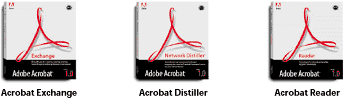
Adobe asked a steep price for the tools to create PDF files. Acrobat Distiller was available in personal and network versions, priced at $695 and $2,495 respectively. You even had to pay 50 dollars for Acrobat Reader. This approach didn’t exactly turn PDF into a popular format overnight. Later on, Adobe dropped the price of Acrobat and launched the free version of Acrobat Reader.
I think important things that should be kept put up should be on paper not on a computer or a floppy disc so I vote on paper if you don’t mind please.
Thank for everything. I know you have my back on this case.
I need help solving an ADOBE/PDF problem.
The problem defined:
3 print companies have each tried unsuccessfully to print two each Galley Books of my manuscript. The manuscript is a PDF document, 47,000 words, generated using Microsoft WORD word processor from Libre Office Suite.
Here is what is uniquely weird: Each of the printed six Galley Books have errors. No two Galley Books have the same errors. The question to be answered is: Where are the errors being generated and why do no two books have the same errors
I had to leave a comment since this post has a long comment history, and the site has a pretty long history. I’ve been PDFin’ the whole time. Started in my 20s in the early 90s at an agency with an AGFA/CompuGraphics imagesetter. I remember tinkering with Acrobat Distiller and Exchange (probably 1 point something) as it was included in an early Illustrator box. I do remember the RGB model and being like, no, no, no, have to fix that. I was using it in some fashion for process color sep output as early as the late 90s. Early on, it was especially helpful to me in getting PC Office/Publisher type work out. I remember using early Pitstop. I still impose, 30+ years later in 2024, thousands of jobs yearly and use Pitstop and Acrobat daily.
my observation here is something you might be able to confirm and add to your ‘history of pdf’ blog page… but Adobe was not the first to have a truly cross-platform full color electronic document viewing technology. Frame Technology, publisher of ‘FrameMaker’ (a long/structured document production software), had a companion viewing application, known as ‘FrameViewer’. It ran on Windows, Mac, and various flavors of Unix. If you check the records, Adobe purchased Frame Technology around the time of this. I personally believe the acquisition was to acquire/understand/leverage-off-of their ‘FrameViewer’ technology before Adobe fully deployed PDF.
I may be mistaken, but I was told by the printer that my 1999 book, The Grammar of Graphics, was the first book ever published in full color using PDF. The publisher was Springer Verlag. The printer was Canadian. They used a beta copy of Adobe PDF composing software and printed and bound my PDF files that I had produced using FrameMaker and Distiller. I had checked with a number of US printers (Donnelly, etc.) before I found the one in Canada willing to try out the Adobe beta software in production.
I worked in a prepress beaureau in the late 90s. AGFA had introduced using PDF for commercial printing in 1998.
we printed PDF Newspaper inserts back in 1996
I have definitely seen PDF used for full-color prints before 1999.
Thanks for this very informative article. I was in the printing/pre-press business back in the ’90s when PDF first came on the scene, so it was interesting to get a behind-the-scenes look at its development. In addition to Common Ground and the other cited potential competitors to PDF, the name “Timbuktu” sticks in my mind as one of that group. Am I “mis-remembering” here? Some might find it of interest that, even though I was a Mac PageMaker and Freehand user for many years, for the past five or six years I’ve been using a Windows-based DTP application called Serif PagePlus, one of whose most significant advantages is its uncanny ability to parse PDF files into editable PagePlus objects and text frames (assuming, of course, that the PDF text is not scanned images — it doesn’t do OCR) for extensive editing or re-purposing of PDF content. I’ve not used any recent versions of Acrobat Professional, but from what I can gather, PP put AP to shame in this regard. A very hand tool to have in one’s “kit”.
is the pdf printer a separate technology from the distiller?
Is there any indication that PDF was ever a commercial success for Acrobat. I´m looking for a discussion on its business model.
Thanks
I don’t quite understand the question. PDF is a file format, Acrobat is the software to create or process such files. I assume that you are curious whether PDF was a commercial success for Adobe? Since it is impossible to make money off a file format, Adobe has never had any direct revenue from PDF. But the popularity of PDF has enabled them to sell tons of Acrobat licenses. There have been quarters where it was their most profitable product range. By controlling the PDF standard and tailoring their software to use its full capabilities, Adobe has managed to make InDesign the most popular design application on the market. The limited PDF support in QuarkXPress is one of the reasons that product has lost marketshare. So has PDF been good for Adobe’s revenue: Yes, it definately has.
I’m looking for file extension libraries, if you can help. Thanks.